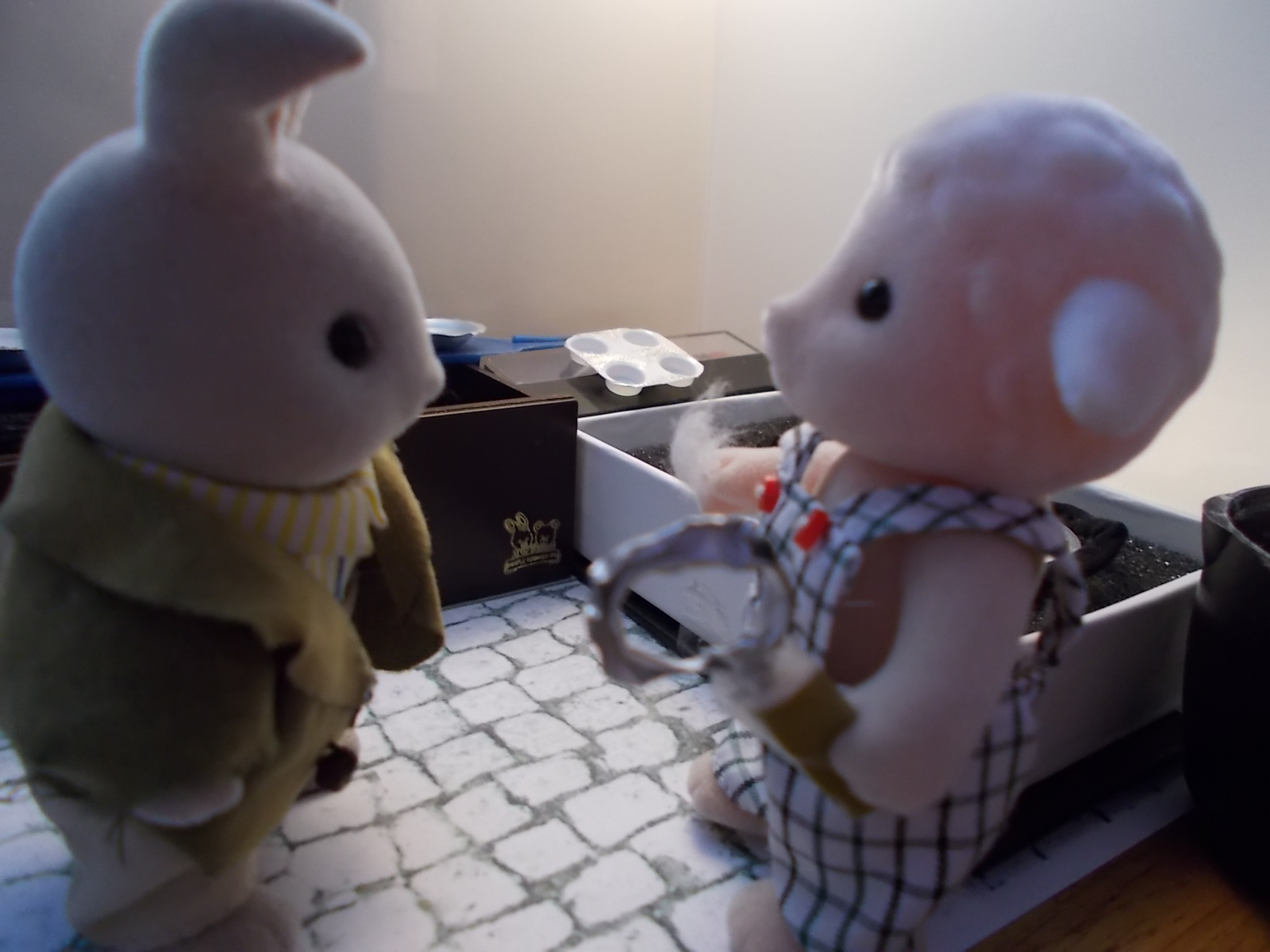
Thinking of my experiences over the past year makes me realise how much I don't know about the world. Who would have thought that humans are real? And I say that intending no offence to my readers. I merely wish to highlight that I am now aware that I'm not all-knowing; a humbling experience but one - I hope - that makes me a more open-minded rabbit.
Why this self examination, you may ask? Well, I've learned something else. It's not as life changing as the events some months back, but it is something I find quite wonderous. The beauty of this is that it's here in Mellowdene.
I'm teasing, I know, but please be patient. I first want to talk about my neighbours.
Butterglove House (and my cousin's home, the slightly older Butterglove Lodge) existed before the rest of the nearby houses were built, forming Dandelion Lane. They vary widely in shape and size, and it was a few years before all thirty-two homes were built. Now, we live at one end and Perry & Anita Babblebrook live at the other end. However, I wish to tell you about the dinky cottage that is our immediate neighbour - number three, Dandelion Lane.
When I say it is a dinky cottage, I use the term advisedly. Being so compact, it would better suit a newlywed couple, and yet the last three sets of residents have been families. And before you ask, yes - people do move homes in Mellowdene.
We have new neighbours. The Marguerites moved in a couple of weeks ago, having previously been living in Daisyville. They seem nice, although I'm still a little confused over their naming traditions. Apparently people born into Daisyville families are given two forenames that they use for different situations. Beverley tells me that it's simple. Official names for official purposes, and social names for social purposes. It seems unnecessarily complicated to me. But as I say, they seem nice.
Landon Marguerite insists I call him Sancho, and... well, never mind. They're in Mellowdene now, and his wife Lisa - or should I say Natalia - says they are likely to settle on their "
cuddla" names. Their social names.
I'm sure I'll adapt. My point, although I'm taking a while to make it, is that this small cottage currently holds four family members, the same number as the previous residents.
The Clearwaters were happy living at number three, but the difficulties with space had grown to the extent that they could no longer cope. Sybil's skills as a seamstress were under increasing demand. Even though she had effectively stopped curtain making (the ones she made for us were a special gift), the haberdashery resources for her dressmaking were making it too difficult to remain. Bolts of fabrics alone took up a full room, meaning Stephanie and Sherman had to share a bedroom.
The opportunity to move to a dressmaking shop with attached accommodation gave them the push they needed. Sherman was particularly sad to be moving further from his friend Orton and, of course, one would have expected Orton to be equally disappointed. But Orton is a funny little chap. I was there when Eliza and Merlin prepared to comfort him, and he showed the same directness of mind that had brought him to Mellowdene.
Seeing Eliza's empathy, he'd reached out to briefly place a comforting paw on her arm. "He's not moving that far away, Auntie. Sherman's sad, but when I remind him that he'll have his own room for us to play in..."
He was interrupted when Eliza rushed towards him and - knowing a huge hug was imminent - Merlin chuckled.
"That's my boy," I heard him say. And that is effectively true.
Before the Clearwaters, the house had been owned by members of the Dale sheep family. Their reason for leaving was the discovery that the size of their family was due to increase imminently. Barbara was pregnant and they'd been told that twins were likely.
In one of those convenient coincidences, Barbara's brother - Dominic Dingle - mentioned that a house had became available close to his home. The additional family support and the proximity to their work - the Dingledale Worm Farm - made the move most attractive.
They were settled in their new home when the twins Emma and Elmo were born.
So - three sets of neighbours in a little over three years. But I promise you - we didn't frighten anyone away!
By now you are probably wondering what our neighbours have to do with the "wonderous" discovery I had made.
It is related to the Dale family.
When they lived next door, Beverley used to play with Iona Dale, but the house move placed unintentional distance between them. My understanding is that they recently moved into the same class at school, and they both realised how they had neglected their friendship. As a consequence, Brendan and Beverley were invited to go for tea.
Upon their return, both of my children were still excited and vocal as to what they'd seen.
"We looked around the worm farm," said Beverley.
"I wouldn't mind having some pet worms..." said Brendan.
"But you know that you're not," said Cecile with an air of finality.
Brendan looked at his mum. "...but I'm not." He rallied. "But you have to see them, mum."
Cecile smiled and shook her head.
He turned to look at me. "Dad?"
"I'm pleased you enjoyed yourself," I said, "but it doesn't sound like my sort of thing."
Beverley nudged me. "Not even if the worms can sing?"
Dingledale Worm Farm is an unusual business. You may have heard of silk worms, but these worms are - I'm told - rarer. Dominic told me their scientific name but he said that there on the farm they simply call them echo worms. He was delighted to explain his work.
"When I first encountered them, they were considered a curiosity by the farmers that kept them. They were used to break down vegetation but someone had discovered that when they ingest the bolls from cotton plants, they produced something similar in twice the quantity."
I roughly knew that these so-called echo worms produced a yarn, but not the details. Dominic was happy to explain.
"A creature that could effectively double cotton yield seemed miraculous to me. I figured it would be a useful business opportunity back in Mellowdene."
"So that's why you started the worm farm?"
"Yep. And it turns out the simulated cotton is more durable, and by being extra kind to the worms the yield can be as much as threefold. Of course, you need the cotton bolls to start with, so we use a combination of locally grown and imported plants. But my lovely wife discovered something by accident. The worms really like fleece when it's added to their diet."
"And that's where your woollen yarn comes from?"
He nodded. "An even bigger yield. And obviously we produce our own fleece so that's free."
It was interesting. However, I hadn't broached the subject that had brought me here. Worms that could - supposedly - sing. It seemed crazy. I was even wondering if Beverley had been teasing me.
Dominic must have noticed my reticence and guessed what I wasn't saying.
"Well, Jackson - as much as I've enjoyed sharing the enjoyment of my work, that's not why you're here, is it? Brendan and Beverley have told you about Squiggle."
"Squiggle?"
"Aw, alright. Come on to Shed 16. I'll introduce you."
I was informed that the worms were farmed in a group of specially constructed sheds. Shed 16 apparently had some significance.
On the way to the worm sheds I encountered three rapidly-moving little lambs, and Dominic introduced them as his daughter Katharina and the Dale twins Emma and Elmo. They had been chasing after each other, laughing whilst running around the sheds, but had come to a halt in front of me.
"Hello Mister Rabbit," Katharina squeaked breathlessly.
Dominic ruffled her fleecy head. "This is Mister Butterglove, Kathy-lamb."
"Beverley's daddy? Has he come to see Squiggle?"
"That's where we're going. Now, go and play with your cousins and take care."
Elmo came forward and tugged on my trouser leg. "Squiggle's good."
I bent down to reply to the tiny Dale twin. "Thank you for telling me. You must be a clever boy."
Emma obviously didn't want to be left out. "No, he's not."
Elmo whirled and moved towards her. She ran off, laughing, and the others resumed their chasing game.
I straightened and noticed Dominic watching them. He was smiling.
"They're delightful, Dom."
"Oh, yes. Kathy's my heart-hugger." He gestured towards the nearby shed. "This is the place. Go on in. The door's open."
o 0 O 0 o
The walls were constructed so that, rather than their being direct sunlight from outside, there was a gentle diffuse illumination. It was relaxing. Around the edges of the room, wooden bins were full of what looked like rich, fibrous soil.
Dominic directed me to one particular bin, sectioned off from the rest. He put his paw into a tub and extracted a small piece of fleece. From somewhere he retrieved a magnifying glass that he handed to me.
"Squiggle's an emperor of the breed so he's quite a large worm. The magnifier will help you see him more clearly, though."
I moved to where Dominic pointed. There was a circular ring embedded in the soil, a membrane stretched across it giving the appearance of a drum or tambourine. As I watched, the worm farmer placed the fleece at the edge of the ring.
"It's a sort of sounding board put there to help amplify the sound," explained Dominic, "and Squiggle will be there shortly - now that he has some wool to munch on."
I looked up. "So Squiggle makes a sound?"
Dominic inclined his head towards the bin. "Just watch. And listen."
I returned my scrutiny to the sounding board, looking through the magnifier. There was movement in the nearby soil. From underneath, a creature emerged. Not quite what I expected, it looked more like a caterpillar than a worm, although it's head was... well, it wasn't worm-like at all. It approached the fleece, paused, twisted to look up at me, and I swear it smiled.
It was like nothing I'd ever seen. I found myself smiling back. This seemed to satisfy it - and yes, I know how crazy that sounds - and it resumed its movement towards the small piece of fleece. Then it started to eat. There was a rippling down the length of its body, a rippling that increased in frequency until it was more of a vibration. The soundboard picked it up. There was an actual melody!
I stared in wonder as Squiggle went through a selection of arpeggios, the clear notes ringing out into the shed. This was the singing of which Beverley enthused.
"Wow." The word was involuntary.
Dominic chuckled. "Just wait."
What else could there be? I'd not seen or heard anything like it. Pure notes and not at random; there were patterns to the sound. But Dominic was right. That wasn't all. And I'm not just talking about the yarn emerging from Squiggle's rear end.
From all around me, music echoed from the other bins. Other worms were responding to Squiggle's song. Harmonies and counterpoint melodies with different tonal qualities. I was amazed.
Afterwards, as I was leaving Dingledale Worm Farm, Dominic told me that it was a comparatively rare occurrence but not unique.
"About one in a thousand emperor echo worms show their enjoyment by singing. It's special when you find one. Squiggle is the best one I've had. It's not uncommon for other worms to respond, but they are particularly vocal with Squiggle. I'm pleased you were able to hear them at their best."
I was still finding it difficult to find the right words. I later decided "wonderous" was the most appropriate description.
The three little lambs reappeared when I was thanking my host.
"Bye bye, Mister Blutterguv," said Katharina.
"Butterglove," Elmo corrected.
"You must be a clever boy," mocked Emma, echoing my earlier words.
Katharina laughed, and they ran back towards the worm sheds.
Dominic chuckled (it seemed a common trait) and shook his head at the children's activities.
A happy place. A happy family. With happy echo worms as their neighbours.
o 0 O 0 o